
Jie Huang, Loughborough University London
Generative artificial intelligence (AI) has attracted growing public and academic attention for its capabilities and transformative potential. Across the Creative Industries, the rapid diffusion of AI tools capable of generating text, images, audio, and video is perceived to be reshaping creative processes and the skills required to sustain them. Yet, despite increasing interest, research on generative AI in creative sectors remains fragmented, lacking a cohesive understanding to capture its complexity and underlying dynamics.
This essay presents intermediary findings from an ongoing body of research examining the role of generative AI in the screen and live performance industries. It draws on three complementary studies: a comprehensive literature review presenting a preliminary synthesis of current research on generative AI in creative fields, an (unpublished) analysis of keywords relating to creative workflows, and an applied framework mapping the potential use of AI tools across filmmaking stages.
Research questions and method
The first stage of the research (published in September 2025) involved a systematic review of 98 peer-reviewed journal articles and conference papers published from 2020 to 2024. The study examines the state of research on the adoption and impact of generative AI in the screen and live performance industries. The review identified major research themes, conceptual relationships, and gaps in existing knowledge, forming the basis of a conceptual framework that outlines generative AI’s role across film, television, gaming, animation, extended reality (XR), and live performance sectors. Analysis of key words in the literature has led to the development of a second paper, digging down further into the literature and focusing in particular on changing approaches to ‘creativity’ and to ‘workflows’.
The second stage of the research takes a more applied approach – building on this conceptual enquiry and mapping the evolving use of AI tools within the filmmaking process. Published as a resource on the CoSTAR website, this complementary strand aims to strengthen the broader investigation by connecting theoretical understanding with sector-specific exploration of how generative AI technologies are emerging in creative production contexts.
Themes and conceptual framework
The systematic review of literature identified five major themes that capture current scholarly and industry perspectives on generative AI across the screen and live performance industries. As illustrated in Figure 1, these include prototypes, real-world applications, technology limitations and ethical concerns, attitudes, and impact. These themes provide an overview of the current research landscape and inform a conceptual framework for understanding how generative AI is being explored and discussed across creative sectors.
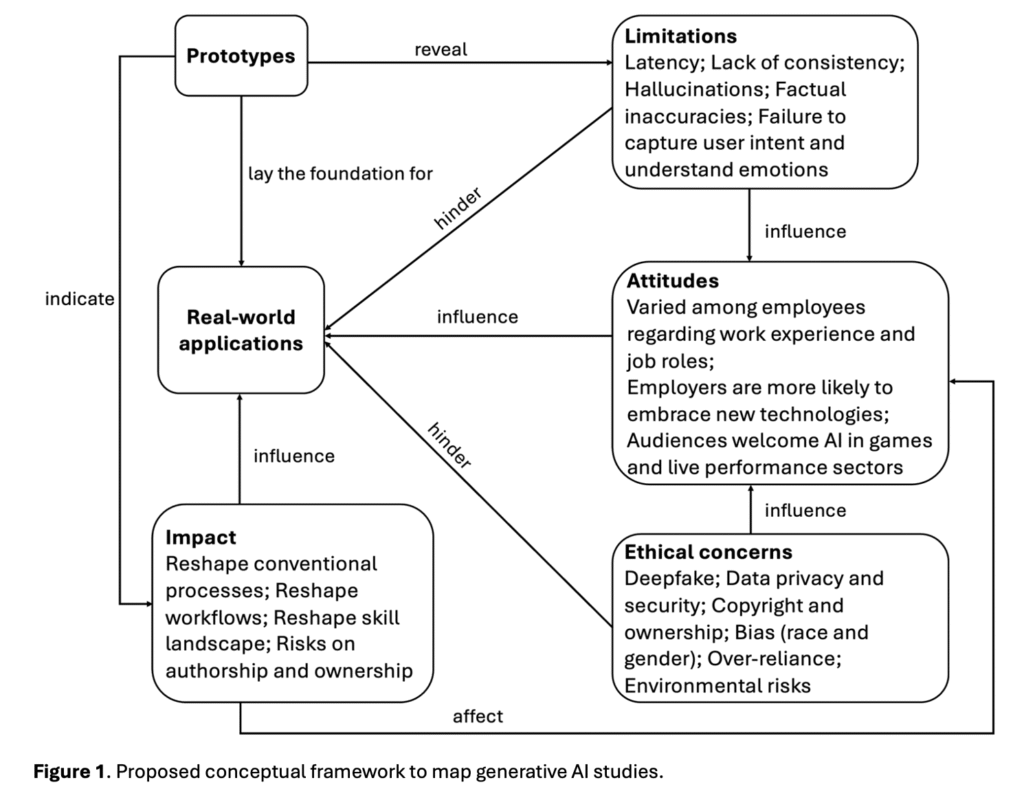
Prototypes represent the current experimental stage of generative AI adoption, with work focusing on developing tailored and practical AI solutions. Studies adopt a balanced approach to assessing generative AI’s role, acknowledging both its opportunities and uncertainties within creative experimentation.
Real-world applications reveal practical challenges such as bias and censorship, highlighting that technical advancements should align with cultural values and ethical considerations. However, only limited attention has been given to ways of addressing these challenges, indicating that the transition from experimentation to large-scale adoption is still incomplete.
Technology limitations and ethical concerns are becoming more apparent and complex. Ethical issues such as bias, transparency, and intellectual property emerge as key constraints shaping how generative AI is developed and applied within creative contexts.
Attitudes toward generative AI vary widely. Existing studies concentrate more on the perspectives of producers, such as creators and industry professionals, than on audiences. This imbalance points to the need for a broader understanding of public perceptions and cultural acceptance.
Impact has been discussed in terms of workflow, productivity, skills, job displacement, and user engagement. Yet few analyses examine these aspects systematically, leaving gaps in understanding how such effects accumulate and interact across creative sectors.
Overall, the adoption of generative AI is not an easy process, constrained by technology limitations and ethical concerns that shape attitudes and acceptance. These attitudes, along with the broader impacts of the technology, directly affect its usage. The impact of generative AI, both positive, such as enhancing efficiency and user engagement, and negative, such as necessitating new skills and causing job displacement, may shape the direction of people’s attitudes and perceptions.
Visualising the evolving research landscape
Based on the analysis of current research themes, this section explores the research trends by focusing on specific keywords that capture the evolving discourse around the adoption and impact of generative AI in the screen and live performance industries. To provide deeper insights, this study identifies recurring terms in the literature, quantifies their frequency, and selects the top 10 keywords that represent critical dimensions of the field, as shown in Figure 2.
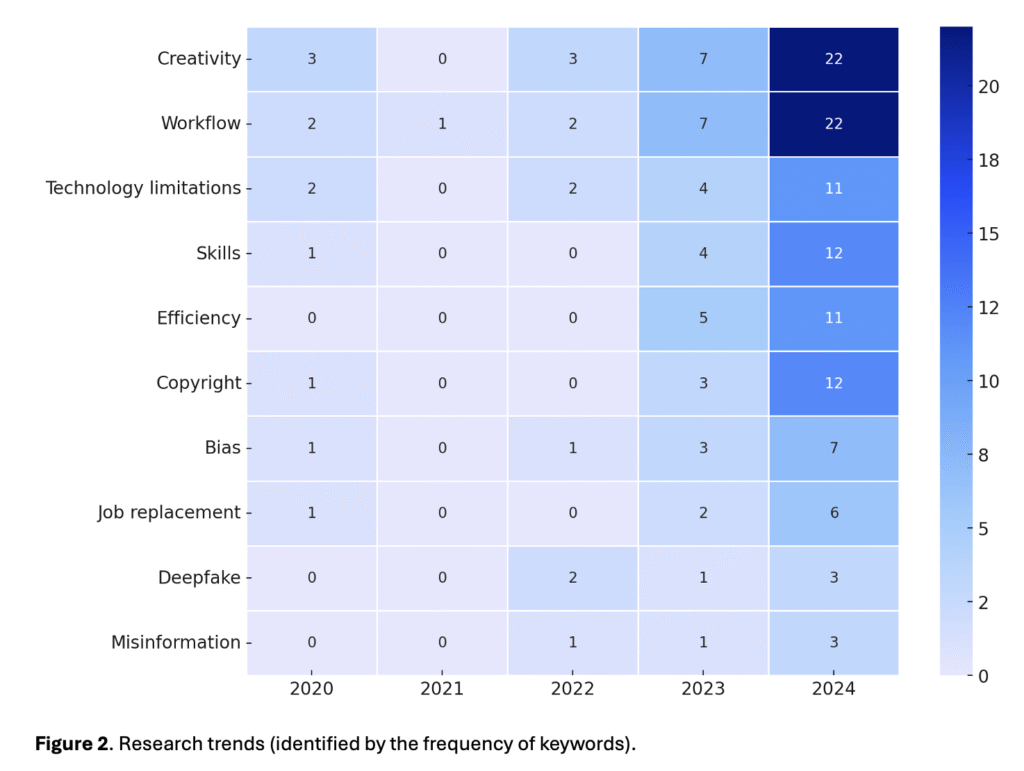
The general trend for the top 10 keywords from 2020 to 2024 shows an upward trajectory. “Creativity” and “Workflow” represent relatively established areas of research, demonstrating high frequencies across the years. In contrast, keywords such as “Technology limitations”, “Skills”, “Efficiency”, “Copyright”, and “Bias” reflect emerging areas of focus. This shift shows an evolution in research priorities, transitioning from established topics to a broader engagement with the technological, practical, and ethical dimensions of generative AI integration.
In the current literature, “Creativity” has been widely discussed. Generative AI’s capacity to produce novel content and provide inspiration challenges traditional concepts of creativity, positioning it not just as an assistant but increasingly as a co-creator, blurring the boundaries between human ingenuity and machine-generated innovation. This blurring raises academic discussions on whether generative AI enhances, diminishes, or redefines creativity, and whether creative industries prioritise innovation over the art of creativity (Zhou and Lee, 2024).
“Workflow” is another key area of research, together with keywords such as “Efficiency”, “Skills”, and “Job replacement”, the literature examines the disruptive impact of generative AI on work dynamics, exploring how these tools streamline workflows, empower productivity, and reshape traditional roles. Critical discussions also address challenges such as over-reliance on automation and emerging skill gaps, prompting questions about how to balance technological advancement with the preservation and enhancement of human expertise.
The fear of “Job replacement” is evident in the literature, showing anxiety among creative workers. This concern is not unfounded, as the introduction of ChatGPT led to a 21% decrease in job postings on writing and coding while image-generating AI caused a 17% reduction in image-related job opportunities (Demirci et al., 2023). In this case, it is unsurprising that some creatives exhibit resistance to generative AI tools due to concerns over job security and diminished job satisfaction. The necessity to acquire new technological skills to remain competitive may also impose an extra burden, potentially intensifying their reluctance (Einola and Khoreva, 2023).
With substantial attention on generative AI, the literature looks into its “Technology limitations”, and ethical issues, including “Copyright”, “Bias”, “Deepfake”, and “Misinformation” rather than solely embracing the technology. Technology limitations may be resolved more readily as advancements lead to continual upgrades and maturation; however, ethical issues present greater complexity. For example, the capability of generative AI to generate new content complicates copyright issues. Bias, embedded in training models, risks amplifying existing stereotypes, posing challenges to fairness and representation (Samuel et al., 2024). Deepfake and dis/misinformation challenge the reliability of information and undermine public trust in digital media content (Vaccari and Chadwick, 2020).
Emerging practices: AI tools in filmmaking
Following the conceptual analysis, the research extends to an applied inquiry exploring how commercial generative AI tools are used, or could be used, within the filmmaking process.
The framework maps the evolving use of AI tools across filmmaking stages in pre-production, production, and post-production. It classifies tools by input and output modalities, identifies the technologies underpinning them, and examines real-world use cases drawn from academic and online sources. This framework is a publicly accessible, work-in-progress resource being developed by the CoSTAR Foresight Lab in collaboration with other labs across the CoSTAR network. It functions both as a knowledge-sharing tool and as an ongoing inquiry into how emerging technologies shape creative processes and externalise their effects. It is currently being extended to other creative sectors, including gaming and live performance.
The structure of the framework is shown in Figure 3. This strand connects the thematic insights from the literature with emerging creative practices, offering a grounded view of how AI technologies are integrated across different stages of film production.

Through the preliminary analysis, it appears that a variety of AI tools are available in the market and could potentially be integrated into production pipelines (Kavitha, 2023). These tools are undergoing continuous iteration, evolving into versatile systems capable of addressing diverse user needs. They are increasingly multi-modal, able to process and integrate different data types. From the framework, evidence suggests that AI tools are more prevalent in post-production, followed by pre-production, and then production stages.
Given the multi-layered nature of filmmaking, which involves text, audio, and visual content, text-based tools appear to dominate, possibly reflecting their greater technical maturity and readiness for real-world application (Swarnakar, 2024). However, compared to the wide range of tools now available, examples of actual use in production environments remain limited or not publicly disclosed. Moreover, tools specifically developed or fine-tuned for film industry contexts are relatively scarce, which may constrain their practical value and adoption.
Options for developing the research
The ongoing research highlights several areas where further investigation is needed to advance the understanding and integration of generative AI in the screen and live performance industries, drawing on insights from both the conceptual review and the applied framework.
- Creative sectors differ in their nature and continue to evolve, making sector-specific research essential to capture their unique dynamics. Findings from the applied framework in film may not be directly transferred to other creative sectors, reinforcing the need for comparative studies across disciplines. Furthermore, most existing research lacks a geographical dimension, limiting understanding of how infrastructure, cultural attitudes, and regulatory frameworks influence the adoption and application of generative AI in different regions.
- Further research is needed to understand how generative AI reshapes creative workflows, skill requirements, and professional roles. Findings from the ‘AI tools in film’ framework indicate that commercial tools show strong potential for use across different stages of production, yet how they precisely transform practical workflows remains unclear. There is also limited knowledge of which skills will be most in demand, who benefits from these tools, and who faces greater risks, with freelancers particularly underrepresented. The broader organisational effects of these changes, along with the potential of AI to support training and skill development, also remain underexplored.
- Current research offers limited insight into the creative industries’ readiness to adopt generative AI. Findings from the applied framework reveal a significant gap between the wide availability of AI tools and their practical use in production, indicating the need to investigate the underlying barriers to integration. Future studies could examine the factors shaping practitioners’ perceptions of AI, explore enablers and constraints within existing production models, and consider how audience attitudes toward AI-generated content may influence broader industry adoption.
- Based on the applied framework, generative AI tools continue to evolve and are designed to manage diverse production tasks, yet their actual functionality and effectiveness in real-world contexts remain unclear. Further research is needed to assess which tools are genuinely useful for creative work and to support the development of locally trained, industry-specific models that can provide more practical and ethical solutions for creative production.
- A key gap concerns the development of regulations that address the specific challenges of generative AI, including new forms of copyright and authorship. Future research should provide evidence to inform policymakers, evaluate frameworks such as the EU AI Act and the UK AI Opportunities Action Plan, and support policies that balance ethical, legal, and societal considerations with innovation.
- Further empirical research is needed to examine how generative AI tools are used in professional creative contexts and how different project types, such as traditional, VR, or experimental films, engage with them. A multidisciplinary approach drawing from management, law, and the humanities would deepen understanding of AI adoption and its implications. Expanding research beyond academic sources to include industry perspectives would also provide a more comprehensive view of market practices and emerging challenges.